
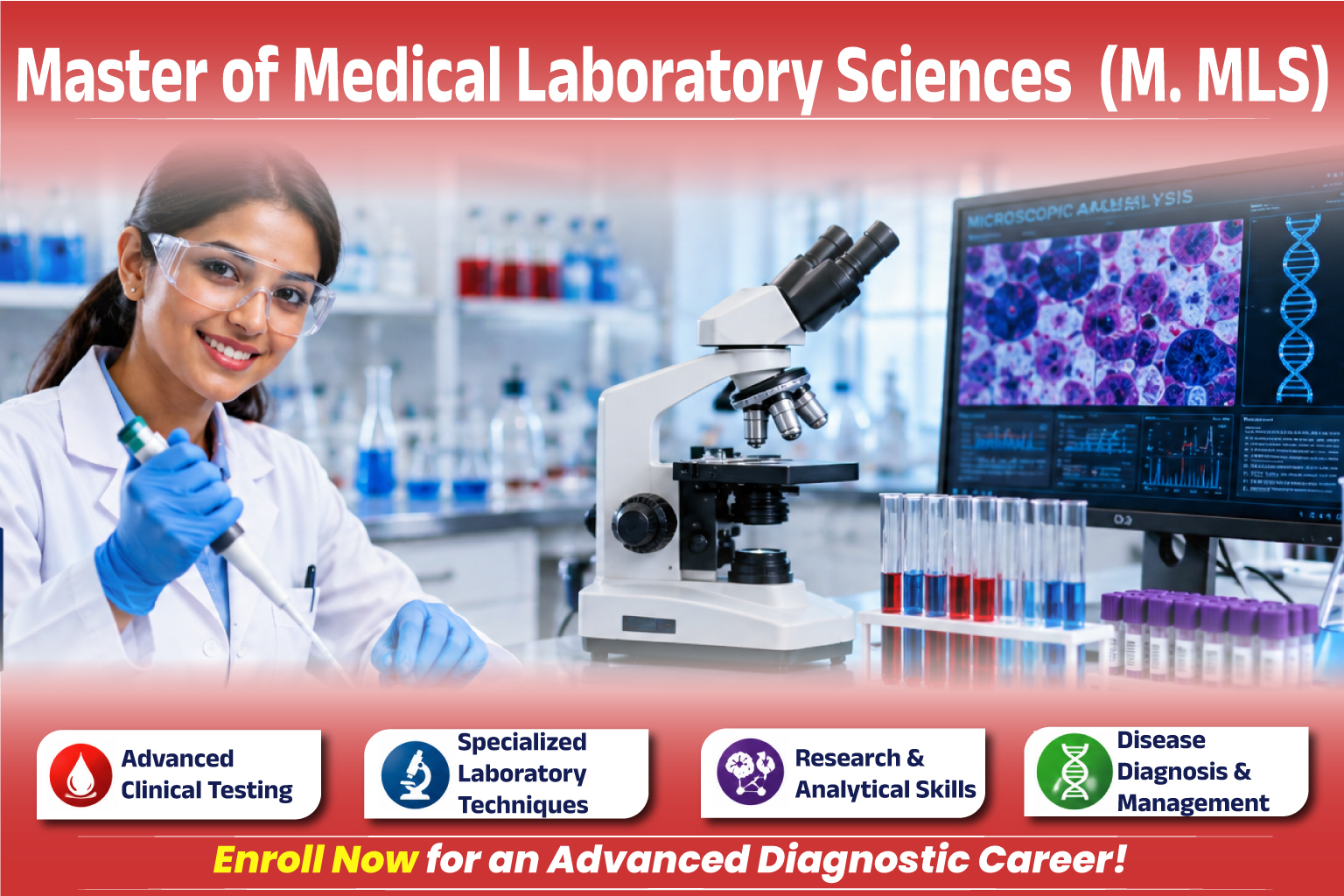
The Master of Medical Laboratory Science (MMLS) is a 2-year Master degree professional program designed as per the standards of the National Commission for Allied and Healthcare Professions.
It is specifically aimed at those pursuing a professional career in medical laboratory science. It is designed to provide specialized training both in basic scientific principles of modern laboratory science and in the application of these principles to laboratory diagnosis and management. It is designed as a higher degree program suitable for graduates having experience in Medical Laboratory Science The program aims to enhance the scientific skills of non-medical graduates with insight into clinical problems that will allow them to work in multidisciplinary teams.
Duration
2 Years(4 Semesters)
High demand in India and abroad (in countries like USA, Canada, UK and Australia)
Critical role in Diagnosis
Career Growth & Specialization (Molecular Diagnostics, Medical Biochemistry, Immunology, Cytotechnology..)
Wide Career Opportunities
Involvement in Medical Research (Medical Laboratory Scientist, Research Associate, Lab Manager, Quality Control Analyst, Diagnostic Specialist..)
Job stability and respect
Pathway to Higher education (Ph.D. in MLS)
In recent decades, rapid advancements in medical technology have significantly improved the quality of healthcare. However, these innovations have also introduced new layers of complexity into healthcare delivery. Today, it is widely recognised that effective healthcare is a multidisciplinary endeavour, requiring the coordinated efforts of a broad spectrum of professionals—both clinical and non-clinical—beyond just physicians and nurses. The growing reliance on sophisticated equipment and standardised protocols has created a strong demand for professionals trained to manage healthcare services independently. As technology becomes central to diagnosis and treatment, these healthcare professionals play a crucial role in ensuring the efficiency, safety, and success of modern healthcare systems. Medical Laboratory Professionals work in close collaboration with physicians and medical laboratory technicians to diagnose and monitor disease processes, as well as to assess the effectiveness of treatment. Their expertise is critical in generating accurate and timely laboratory data that guide clinical decision-making. The training of medical laboratory scientists spans a wide range of disciplines, including microbiology, clinical chemistry, haematology, immunology, transfusion medicine, toxicology, and molecular diagnostics, equipping them to perform complex analyses and ensure quality in laboratory testing.
India’s rapidly evolving healthcare landscape has intensified the demand for skilled medical laboratory science professionals. With increasing patient loads, the rise of noncommunicable diseases, and the growing emphasis on evidence-based medicine, accurate and timely diagnostics have become a cornerstone of effective healthcare delivery. However, a significant shortage of trained medical laboratory scientists exists, particularly in rural and underserved regions. As diagnostic technologies become more sophisticated— encompassing molecular testing, automation, and personalised medicine—the need for professionals trained in advanced laboratory methods has become more urgent. Strengthening the medical laboratory workforce is crucial not only for improving diagnostic accuracy but also for ensuring the quality and reliability of healthcare across India. India has an estimated shortfall of almost eight times (~57.5-58 lakh) of the current availability of allied healthcare professionals. This shortage is even higher if it is adjusted for workforce with proper qualifications, which takes the number of professionals to five lakh, increasing the shortfall to nearly 60 lakhs (13 times). (Reference: NCAHP – MLS curriculum, 2025)
Upon successful completion of the course, Post-Graduates can have the following career opportunities.

